

Engineering Plastic Balls
HEMSUN ENGG. INDUSTRIES manufactures precision Engineering Plastic Balls, valve balls, and custom engineered polymer components at our Dahegam (Gujarat) facility. Browse standard sizes, material grades, and technical specifications below.
Working principle and engineering architecture
The manufacturing engineering of Engineering Plastic Balls centers on void-free polymer processing. Granular suspension fluoropolymer resins are compacted under 20 to 35 MPa (3,000 to 5,000 psi) in vacuum-hardened steel dies to form high-density green preforms. These undergo programmable thermal sintering cycles (soaking at 360°C to 380°C with controlled crystallite gel dwell and gradual cooldown). Finished components are precision-machined with diamond-tipped CNC tooling or centerless-ground to achieve Grade 1 / Grade 2 tolerances (sphericity within 0.002 mm and mirror surface finish Ra ≤ 0.2 µm).
Crystallinity control during thermal fusion is critical to preventing micro-void formation and cold flow in dynamic valve seating applications. Our computer-controlled sintering ovens follow multi-ramp thermal schedules with uniform air circulation, ensuring uniform core-to-surface fusion. For spherical ball products, proprietary multi-stage centerless lapping and optical profile sorting guarantee 100% spherical seating and bubble-tight shutoff against aggressive industrial chemicals and high-purity pharmaceutical fluids.
Types & Configurations We Build





Sizing and capacity calculations
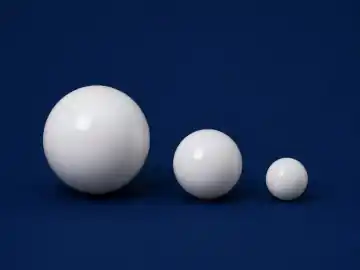
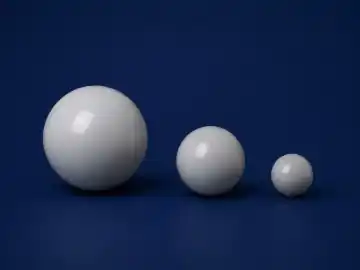
Engineering Plastic Balls encompasses precision-moulded and CNC-machined components engineered for demanding sealing, fluid metering, and corrosive chemical handling. Manufactured from premium virgin granular suspension PTFE resin, specialized filled compounds (Glass, Carbon, Bronze, MoS₂), and engineering polymers (PEEK, Delrin, UHMWPE, PVDF), our products undergo controlled isostatic and uniaxial compaction, thermal fusion sintering, and multi-axis CNC diamond finishing to eliminate internal porosity, stress cracking, and dimensional drift.
Sizing & Tonnage Calculations:
To calculate material requirements and component sizing, part weight and stock allowance are determined directly from solid polymer specific gravity:
Formula: Part Mass (g) = Finished Volume (cm³) × Specific Gravity (g/cm³) × 1.10 Machining Allowance
Example: A Ø50 mm solid virgin PTFE ball (Volume = 65.45 cm³, density 2.16 g/cm³) requires 155 grams of virgin granular resin before precision centerless finishing. Tensile strength is verified above 25 to 35 MPa with elongation exceeding 250% to 350% per ASTM D4894.
Technical specifications and machine parameters
| Parameter / Specification | Standard Range / Feature |
|---|---|
| Product Family | Engineering Plastic Balls (Precision Polymer Range) |
| Dimensional Tolerances | Grade 1 (±0.002 mm) / Grade 2 (±0.005 mm) / Standard (±0.05 mm) |
| Continuous Operating Temp | -200°C to +260°C (-328°F to +500°F) |
| Specific Gravity | 2.14 to 2.18 g/cm³ (ASTM D792 / D4894) |
| Tensile Strength | 20 to 35 MPa (2,900 to 5,000 psi) |
| Hardness & Surface Finish | 55 to 65 Shore D, Ra ≤ 0.2 µm Mirror Ground |
| Compliance & Origin | Moulded from FDA 21 CFR 177.1550 listed resin / RoHS / Made in Dahegam, Gandhinagar, Gujarat, India |
Material compatibility and engineering metallurgy
- Virgin PTFE (Suspension Grade): 100% pure granular suspension resin with zero additives, moulded from FDA 21 CFR 177.1550 listed resin for pure chemical and food contact service.
- Glass-Filled PTFE (15% / 25%): Enhanced compressive strength, wear resistance, and reduced cold flow for valve seats and bushes.
- Carbon & Graphite-Filled PTFE: Improved thermal conductivity, lower coefficient of friction, and anti-static properties for dynamic seals.
- Bronze-Filled PTFE (40% / 60%): Superior compressive load bearing and extreme wear resistance for hydraulic guide rings and bearings.
- Engineering Thermoplastics (PEEK / Delrin / UHMWPE): High-modulus polymer alloys for high-pressure valve components, float balls, and precision gears.
Procurement and tooling selection guide
Key engineering criteria when procuring polymer components:
- Material Formulation: Select virgin PTFE for FDA purity, or reinforced grades (15–25% glass for creep resistance, 15–25% carbon for thermal conductivity, 40–60% bronze for compressive load wear).
- Sphericity & Dimensional Tolerances: Specify Grade 1 (±0.002 mm) or Grade 2 (±0.005 mm) for valve seating applications.
- Surface Roughness: Require mirror ground Ra ≤ 0.2 µm to ensure bubble-tight shutoff in check valves and metering pumps.
- Regulatory Documentation: Ask for resin lot traceability against FDA 21 CFR 177.1550, plus the resin manufacturer’s RoHS/REACH declarations for your file.
Testing, inspection and global commissioning
HEMSUN ENGG. INDUSTRIES supplies all Engineering Plastic Balls with comprehensive batch test reports including specific gravity verification, tensile & elongation testing (ASTM D4894 / D4745), optical sphericity inspection, and protective moisture-barrier packaging.
Frequently Asked Questions
When should I choose engineering plastic balls instead of PTFE?
Choose Delrin, nylon, PP, UHMWPE, or PEEK when you need higher stiffness, load capacity, or lower cost — and your media is not highly corrosive or above +120°C. Compare Delrin vs PTFE (/delrin-vs-ptfe) for valve and pump design.
Which engineering plastic ball floats on water?
Polypropylene (~0.90 g/cm³) and UHMWPE (~0.94 g/cm³) float on water. PTFE and Delrin sink. See PP balls (/pp-ball) for level float applications.
What is the best plastic ball for abrasive slurry pumps?
UHMWPE balls (/uhmwpe-ball) offer the highest abrasion resistance among our engineering plastics. For chemical slurries at high temperature, consider glass-filled custom PTFE (/custom-ptfe-ball).
Do you supply PEEK balls for high-temperature valve programs?
Yes. PEEK balls (/peek-ball) operate to +250°C continuous with high mechanical strength — standard in chromatography pumps and oil & gas check valves.
Can engineering plastic balls replace PTFE in check valves?
Only when chemical compatibility and temperature allow. PTFE remains the default for acids, solvents, and cryogenic service. Delrin and nylon suit pneumatic and fuel-system check valves.
What sizes are available for engineering plastic balls?
Standard diameters from 6 mm to 50.8 mm across Delrin, PP, nylon, UHMWPE, and PEEK. Custom sizes are quoted to drawing — our PTFE range is 5 mm to 310 mm.