
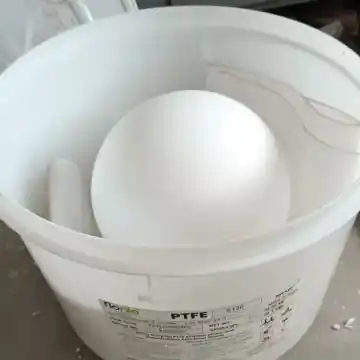
Filled PTFE Balls — Material Specifications, Engineering Data & OEM Supply
Produced at our Gujarat manufacturing works, Filled PTFE Balls offers superior sealing and wear resistance for precision valve balls. Combines virgin and reinforced PTFE fluoropolymer grades with precision compression moulding and 100% batch quality inspection for OEM applications.
Where Filled PTFE Ball is used
Sealing and flow-control element in ball valves and pump check seats, where sphericity and surface finish decide shutoff tightness and operating torque.
PTFE suits check and valve balls because it seats against metal without galling and needs no lubricant that could contaminate the line.
Key properties
Lower cold flow
Filled grades resist creep under sustained seat load far better than virgin PTFE, so the ball keeps its sphericity and keeps sealing.
Higher wear resistance
Wear rate can drop by an order of magnitude versus virgin PTFE, which directly extends replacement intervals in high-cycle pumps.
Greater compressive strength
Roughly double that of virgin PTFE, allowing higher seat loads and system pressures without permanent deformation.
Better dimensional stability
Lower thermal expansion means the ball holds its fit across a wider operating temperature swing.
Improved thermal conductivity
Bronze and carbon grades conduct heat away from the contact zone instead of letting it build up.
Same chemical breadth
Filler choice must suit the media — but the PTFE matrix keeps the chemical resistance that made you specify PTFE in the first place.
Specifications
| Property | Value |
|---|---|
| Component Type & Grade | Filled PTFE Balls (Specification Code HES-616) |
| Base Raw Material | PTFE fluoropolymer (Virgin FDA 21 CFR 177.1550 / Custom Filled) |
| Continuous Service Temp. | -200°C to +260°C (-328°F to +500°F) |
| Tensile Strength at Break | 20 to 35 MPa (Virgin) / 14 to 25 MPa (Filled) |
| Elongation at Break | 250% to 450% (ASTM D4894) |
| Specific Gravity / Density | 2.14 to 2.18 g/cm³ (ASTM D792) |
| Dielectric Strength | 50 to 80 kV/mm (0.1 mm film) |
| Surface Roughness Finish | Diamond Polished Ra ≤ 0.20 µm to Ra ≤ 0.40 µm |
| Dimensional Tolerance | ISO Grade 1 to Grade 3 / Drawing Nominals (±0.02 mm) |
| Manufacturing & Origin | Moulded, Sintered & CNC Machined in Dahegam, Gandhinagar, Gujarat, India |
Available sizes
Filled grades are available across our full diameter range. Note that filled PTFE grinds to a slightly different surface character than virgin — tell us your tolerance and finish requirement and we will confirm against your specific diameter rather than quote a generic band.
| Size | Metric | Inch | Tolerance |
|---|---|---|---|
| 1/4" | 6.35 mm | 0.250" | ± 0.05 mm |
| 3/8" | 9.525 mm | 0.375" | ± 0.05 mm |
| 1/2" | 12.70 mm | 0.500" | ± 0.05 mm |
| 3/4" | 19.05 mm | 0.750" | ± 0.08 mm |
| 1" | 25.40 mm | 1.000" | ± 0.10 mm |
| 2" | 50.80 mm | 2.000" | ± 0.15 mm |
| 4" | 101.60 mm | 4.000" | ± 0.25 mm |
| Large | up to 310 mm | up to 12.2" | To drawing |
How this part is made
Filler and PTFE resin are blended to the specified loading — typically 15% or 25% glass, 25% carbon, or 40% to 60% bronze by weight. Blend uniformity matters: an uneven distribution creates weak zones that fail early in service.
The compound is compacted in a die under controlled pressure. Filled compounds flow differently from virgin resin, so compaction pressure and dwell are adjusted per grade to avoid density gradients.
The preform is sintered on a controlled heating and cooling ramp. Filled grades are more sensitive to thermal shock than virgin PTFE, so the cooling ramp is slower to prevent internal cracking around filler particles.
Sintered blanks are turned to near-net sphere, then centerless ground. Filled grades are more abrasive on tooling, so cutting parameters and wheel selection differ from the virgin route.
Every batch is checked for diameter, roundness and surface condition, with density verification confirming correct filler loading and void-free consolidation.
Material selection notes
Designed around the molecular stability of PTFE fluoropolymer, Filled PTFE Balls offers continuous service in harsh environments with zero chemical attack from oxidizing media. Custom compounding with carbon, bronze, or glass fillers enhances load-bearing capability under dynamic cycling.
How to specify your order
RFQ requirements for Filled PTFE Balls: Please state critical bore and surface finish tolerances, operating fluid media, and required quantity. Our engineering team verifies production feasibility and issues comprehensive commercial proposals promptly.
Quality checks and inspection
Our in-house quality inspection team tests Filled PTFE Balls across multiple critical parameters: raw resin lot traceability, preform green density, sintered tensile strength, and finished dimensional compliance using calibrated digital gauges.
Ordering and export documentation
Domestic Filled PTFE Balls orders ship with GST invoice and e-way bill where applicable. Export orders include commercial invoice, packing list, and certificate of origin from our IEC-registered works. Air and sea freight packing with desiccant and shock protection for international buyers Contact info@hemsun.com or sales@hemsun.com with your balls specification.
Export packing and lead time
We export Filled PTFE Balls to industrial clients across 30+ countries. Shipments include full customs compliance paperwork, Certificate of Origin, and robust export crating engineered for safe international freight.
Storage and handling
Handling and assembly guidelines for Filled PTFE Balls: Components should be kept in protective polybags until final assembly. Use clean, rounded assembly mandrels when installing over shaft threads to prevent surface scratches or edge nicking.
Material comparison
Choosing the filler is the whole decision. Each one trades something away — this table is what actually differs in service.
| Characteristic | Filled PTFE Balls | Alternative |
|---|---|---|
| Glass-filled (15–25%) | Best general-purpose upgrade. Large reduction in cold flow and wear, good compressive strength. | Avoid in hydrofluoric acid and strong caustic — these attack the glass filler even though PTFE resists them. |
| Carbon-filled (25%) | Excellent wear resistance and thermal conductivity. Chemically resistant across almost the full PTFE range. | Electrically conductive, so unsuitable where insulation is required. Black colour only. |
| Bronze-filled (40–60%) | Highest wear resistance and thermal conductivity, best load-bearing capability of the common grades. | Not for chemical service — bronze corrodes in acids and is unsuitable for food, pharmaceutical or potable water contact. |
| Graphite-filled | Lowest friction of the filled grades, good for sliding contact and non-lubricated movement. | Lower compressive strength than glass or bronze grades. Electrically conductive. |
| Virgin PTFE (no filler) | Widest chemical resistance, non-leaching, FDA-compliant resin available, electrically insulating. | Lowest wear resistance and highest cold flow — it deforms under sustained seat load. |
Compliance & Standards
HEMSUN is a DGFT IEC registered exporter (Government of India). Filler content and sintered density are verified per ASTM D792 on each batch, with tensile and elongation checked per ASTM D4894. A mill test certificate stating the lot, filler content and measured values ships with the order. Export paperwork — commercial invoice, packing list and certificate of origin — accompanies international despatch.
Frequently Asked Questions
When should I use filled PTFE instead of virgin PTFE?
When the failure mode is mechanical rather than chemical. If your virgin PTFE balls come out of service chemically undamaged but flattened at the seat contact, scored or out of round, the problem is cold flow or wear and a filled grade will last considerably longer. If they come out swollen, cracked or chemically attacked, a filler will not help — you need a different polymer.
Does adding a filler improve chemical resistance?
No — it usually reduces it. Virgin PTFE already resists nearly every industrial chemical. Adding glass, carbon or bronze introduces a material that can be attacked even when the PTFE matrix is not. Glass-filled grades in particular should not be used in hydrofluoric acid or strong caustic, and bronze-filled grades are unsuitable for most acid service.
Can filled PTFE balls be used in food or pharmaceutical applications?
Generally no, and this is important. Filled grades contain particles that can shed into the product stream, so regulated food, beverage, pharmaceutical and potable water applications specify virgin PTFE instead — accepting shorter wear life in exchange for purity. Bronze-filled grades are definitively unsuitable for contact service.
What is cold flow, and why does it matter for check balls?
Cold flow (creep) is PTFE’s tendency to deform permanently under sustained mechanical load, even at room temperature. In a check valve, the ball is pressed against its seat continuously, so over time a flat develops at the contact point and the ball stops sealing. Fillers restrain the polymer chains and reduce this substantially — it is the single most common reason to move from virgin to filled grade.
Which filled grade should I choose?
Glass-filled 25% is the usual starting point for general high-cycle valve and pump duty. Choose carbon-filled where you need better thermal conductivity and broader chemical compatibility than glass allows. Choose bronze-filled only for demanding mechanical duty in non-corrosive, non-contact service. Tell us the media, temperature, pressure and cycle rate and we will recommend rather than upsell.
Are filled PTFE balls more expensive than virgin?
Per piece, usually yes. In service, often not — if a filled ball lasts five times longer in a high-cycle pump, the cost per operating hour is lower and you avoid four maintenance interventions. Price the change on replacement interval, not on unit cost.
Can you supply filled PTFE balls to a custom diameter?
Yes. We fabricate dies in-house, so custom diameters from 5 mm to 310 mm are routine in filled grades as well as virgin. Send a drawing with diameter, tolerance, filler type and loading.
Related Machinery, Tooling & Technical Guides
Manufacturing Presses
Engineering Process Guides
Learn More

Can PTFE Balls Be Used in Drinking Water Systems?
View DetailsChoosing the Right Ball Size for a Check Valve
View Details