
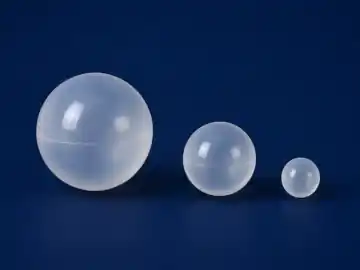
FEP Ball — Material Specifications, Engineering Data & OEM Supply
FEP Ball is manufactured in Gujarat by HEMSUN ENGG. INDUSTRIES, providing tight dimensional accuracy and long service life in precision valve balls. Features premium FEP compounding, void-free sintering, and precision CMM inspection.
Where FEP Ball is used
Sealing and flow-control element in ball valves and pump check seats, where sphericity and surface finish decide shutoff tightness and operating torque.
Selected where melt-processable fluoropolymer is needed
near-PTFE chemical resistance with transparency and weldability.
Supplied to drawing across the published range — Diameter
5mm to 310mm — industry-leading FEP Ball size range; Material: FEP (Fluorinated Ethylene Propylene) — premium fluoropolymer — with dimensional and material reports on request.
Key properties
Diameter
5mm to 310mm — industry-leading FEP Ball size range
Material
FEP (Fluorinated Ethylene Propylene) — premium fluoropolymer
Grade
ISO 3290 Grade G10 precision
Near-PTFE chemical resistance
all acids, alkalis, solvents
Optically transparent / clear
visual ball inspection possible
More flexible than PTFE
better conforming seat contact
Temperature range
-200°C to +200°C
FDA 21 CFR compliant
food and pharmaceutical safe
Gas Permeability
very low
Surface
non-stick, non-contaminating
Typical Use
semiconductor, pharmaceutical, and laboratory valve applications
IEC registered
export-ready quality
Specifications
| Property | Value |
|---|---|
| Component Type & Grade | FEP Ball (Specification Code HES-721) |
| Base Raw Material | FEP (Virgin FDA 21 CFR 177.1550 / Custom Filled) |
| Continuous Service Temp. | -200°C to +260°C (-328°F to +500°F) |
| Tensile Strength at Break | 20 to 35 MPa (Virgin) / 14 to 25 MPa (Filled) |
| Elongation at Break | 250% to 450% (ASTM D4894) |
| Specific Gravity / Density | 2.14 to 2.18 g/cm³ (ASTM D792) |
| Dielectric Strength | 50 to 80 kV/mm (0.1 mm film) |
| Surface Roughness Finish | Diamond Polished Ra ≤ 0.20 µm to Ra ≤ 0.40 µm |
| Dimensional Tolerance | ISO Grade 1 to Grade 3 / Drawing Nominals (±0.02 mm) |
| Manufacturing & Origin | Moulded, Sintered & CNC Machined in Dahegam, Gandhinagar, Gujarat, India |
Manufacturing process
Our dedicated manufacturing cells produce FEP Ball from premium FEP powder stock. After uniaxial preforming in precision tooling, components undergo computer-monitored sintering cycles and diamond-tooled CNC profiling to hold exact drawing dimensions.
Material selection notes
Featuring FDA-compliant virgin FEP or specialized filled compounds, FEP Ball provides reliable sealing and low-friction motion under continuous operating temperatures up to +260°C. Filler additions enhance mechanical rigidity, wear resistance, and thermal conductivity for heavy mechanical loads.
How to specify your order
To evaluate FEP Ball for your project, submit component PDF drawings and resin requirements. HEMSUN engineers review part geometry, recommend appropriate compression tooling or CNC machining approaches, and provide competitive commercial proposals.
Quality checks and inspection
Quality assurance for FEP Ball includes 100% optical dimensional inspection, digital micrometer verification, CMM coordinate layout testing, and water displacement specific gravity checks according to ASTM D792. High-voltage spark testing up to 80 kV/mm verifies absence of internal pinholes and voids.
Ordering and export documentation
Domestic FEP Ball orders ship with GST invoice and e-way bill where applicable. Export orders include commercial invoice, packing list, and certificate of origin from our IEC-registered works. Recurring supply schedules supported with fixed drawing revision and lot numbering for plant stores Contact info@hemsun.com or sales@hemsun.com with your balls specification.
Export packing and lead time
Export customers receive complete logistics assistance for FEP Ball, including FOB/CIF shipping quotes, express air courier delivery for prototype samples, and secure sea-freight container packing with full batch traceability.
Storage and handling
Storage and operating notes for FEP Ball: Keep parts in sealed packaging at ambient room temperature. During equipment overhaul, inspect sealing lips for particulate embedding and replace components showing mechanical wear.
Compliance & Standards
HEMSUN is a DGFT IEC registered exporter (Government of India). Diameter and sphericity are verified on calibrated gauges and the achieved grade is recorded on the inspection report; sintered density is checked per ASTM D792. A mill test certificate ships with the order. Export paperwork — commercial invoice, packing list and certificate of origin — accompanies international despatch.
Frequently Asked Questions
Why are FEP Balls transparent while PTFE Balls are white and opaque?
FEP is melt-processable — it is processed through extrusion like standard thermoplastics, producing a dense, optically clear material. PTFE cannot be melt-processed — it is compression-molded, producing a white opaque structure. FEP's transparency allows visual inspection of the ball condition in clear-bodied valves and flow control assemblies.
What is the largest FEP Ball you manufacture?
We manufacture FEP Balls up to 310mm diameter.
Is FEP Ball chemical resistance the same as PTFE Ball?
FEP Balls offer near-PTFE chemical resistance — resistant to virtually all industrial chemicals including strong acids, alkalis, and solvents. The main difference: FEP is limited to +200°C vs PTFE's +260°C, and FEP has slightly lower chemical resistance to certain high-concentration fluorinated media.
Related Machinery, Tooling & Technical Guides
Manufacturing Presses
Engineering Process Guides
Related Products
Related Articles

Can PTFE Balls Be Used in Drinking Water Systems?
View DetailsChoosing the Right Ball Size for a Check Valve
View Details