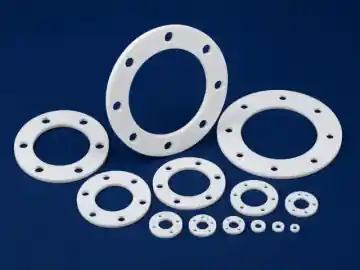

PTFE Gasket for High-Temperature Service — bolt load is the whole problem
A flange gasket is held tight by bolt load, and PTFE loses bolt load at temperature faster than almost any other gasket material. That, not the published temperature rating, is what determines whether a PTFE gasket holds a hot joint.
Where PTFE Gasket for High-Temperature Service is used
Glass-filled PTFE resists creep well and keeps chemical resistance, making it the common choice for hot chemical flanges. Expanded PTFE conforms better to imperfect or warped flange faces. Unfilled skived sheet suits cool, low-cycle joints only.
Weeping after thermal cycling is the signature. A gasket removed for inspection will typically be visibly thinner at the bolt circle — that thinning is the failure mechanism made visible.
Key properties
Service
hot process lines, jacketed vessels, thermal-cycling flanges
Typical failure
bolt load relaxation and joint weeping after cycling
How it behaves here
PTFE cold-flows out of the joint under sustained compression, and heat accelerates it sharply. The bolts do not loosen — the gasket thins, so the bolt stretch that provided the load is taken up and the compressive stress on the seating face falls away.
Where it does not belong
This is why an unfilled PTFE gasket often disappoints in hot service even though the material is nominally rated for the temperature. Filled and expanded PTFE grades resist the flow far better; a plain skived sheet gasket is the worst choice for a hot flange.
Specifications
| Property | Value |
|---|---|
| Service condition | Hot process flanges, thermal cycling |
| Governing factor | Bolt load relaxation through creep at temperature |
| Recommended compounds | Glass-filled PTFE; expanded PTFE for imperfect faces |
| Avoid | Plain skived unfilled sheet on hot, cycling joints |
| Assembly note | Crossing torque pattern; retorque after first heat cycle |
| Standards referenced | Cut to ASME B16.21 / DIN EN 1514-1 dimensions where specified |
Manufacturing process
Cut or machined from sintered sheet, or moulded to the flange profile for larger and non-standard sizes.
Material selection notes
PTFE cold-flows out of the joint under sustained compression, and heat accelerates it sharply. The bolts do not loosen — the gasket thins, so the bolt stretch that provided the load is taken up and the compressive stress on the seating face falls away.
How to specify your order
Glass-filled PTFE resists creep well and keeps chemical resistance, making it the common choice for hot chemical flanges. Expanded PTFE conforms better to imperfect or warped flange faces. Unfilled skived sheet suits cool, low-cycle joints only.
Quality checks and inspection
Dimensions are verified on CMM against your drawing. Filler content and sintered density are checked per ASTM D792, with tensile and elongation per ASTM D4894. A mill test certificate stating the lot, filler content and measured values ships with the order.
Ordering and export documentation
Follow a crossing torque pattern and retorque after the first heat cycle wherever the joint allows it. Most reported hot-flange PTFE failures are joints that were never retorqued.
Export packing and lead time
HEMSUN is a DGFT IEC registered exporter (Government of India). Commercial invoice, packing list and certificate of origin accompany international despatch.
Storage and handling
Weeping after thermal cycling is the signature. A gasket removed for inspection will typically be visibly thinner at the bolt circle — that thinning is the failure mechanism made visible.
Compliance & Standards
HEMSUN is a DGFT IEC registered exporter (Government of India). Filler content and sintered density are verified per ASTM D792 on each batch, with tensile and elongation checked per ASTM D4894.
Frequently Asked Questions
What PTFE Gasket for High-Temperature Service options does HEMSUN manufacture?
A flange gasket is held tight by bolt load, and PTFE loses bolt load at temperature faster than almost any other gasket material. That, not the published temperature rating, is what determines whether a PTFE gasket hold…
Can you supply PTFE Gasket for High-Temperature Service for OEM and export orders?
Yes. We support prototype lots, recurring OEM programmes, and export packing with material certificates and dimensional inspection reports on request. Typical RFQ response is within one business day when drawings are complete.
How do I request a quote for PTFE Gasket for High-Temperature Service?
Send material grade, dimensions or drawing, quantity, application media, and operating temperature/pressure via https://hemsun.com/contact. Our engineering team confirms manufacturability, lead time, and pricing.