
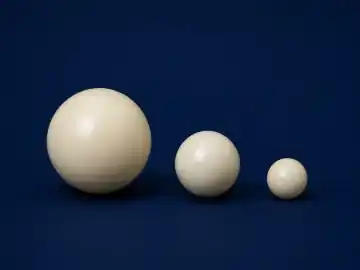
Nylon Ball — Material Specifications, Engineering Data & OEM Supply
Engineered by HEMSUN ENGG. INDUSTRIES, Nylon Ball is designed for demanding valve, pump, and mechanical sealing duties. Built from high-purity polyamide nylon to withstand temperatures from -200°C to +260°C with zero chemical degradation in harsh media.
Where Nylon Ball is used
Sealing and flow-control element in ball valves and pump check seats, where sphericity and surface finish decide shutoff tightness and operating torque.
Selected for strength and stiffness at moderate cost, accepting that nylon absorbs moisture and moves dimensionally with humidity.
Key properties
High Wear Resistance
Outstanding resistance to friction and abrasive wear, ensuring a long life in mechanical systems.
Mechanical Toughness
High impact strength and resilience absorb shocks without cracking.
Self-Lubricating
Low friction properties reduce the need for external grease in sliding configurations.
Temperature Tolerance
Operates continuously from -40°C up to +110°C in dry conditions.
Good Solvent Resistance
Resistant to oils, grease, fuels, and organic solvents.
Noise Dampening
Absorbs vibration and operates quietly compared to metal spheres.
Precision Sphericity
Rigid structure allows centerless grinding to precise tolerances.
High Load Capacity
Better mechanical load limits than soft fluoropolymers like PTFE.
Specifications
| Property | Value |
|---|---|
| Component Type & Grade | Nylon Ball (Specification Code HES-930) |
| Base Raw Material | polyamide nylon (Virgin FDA 21 CFR 177.1550 / Custom Filled) |
| Continuous Service Temp. | -200°C to +260°C (-328°F to +500°F) |
| Tensile Strength at Break | 20 to 35 MPa (Virgin) / 14 to 25 MPa (Filled) |
| Elongation at Break | 250% to 450% (ASTM D4894) |
| Specific Gravity / Density | 2.14 to 2.18 g/cm³ (ASTM D792) |
| Dielectric Strength | 50 to 80 kV/mm (0.1 mm film) |
| Surface Roughness Finish | Diamond Polished Ra ≤ 0.20 µm to Ra ≤ 0.40 µm |
| Dimensional Tolerance | ISO Grade 1 to Grade 3 / Drawing Nominals (±0.02 mm) |
| Manufacturing & Origin | Moulded, Sintered & CNC Machined in Dahegam, Gandhinagar, Gujarat, India |
Available sizes
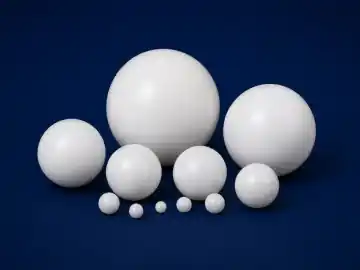
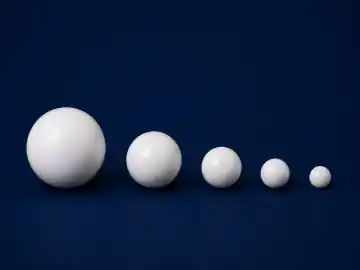
We manufacture nylon balls in standard metric and fractional sizes. The following table showcases standard diameters.
| Size | Metric | Inch | Tolerance |
|---|---|---|---|
| 1/4″ | 6.00 mm | 0.250″ | ±0.03 mm |
| 3/8″ | 9.52 mm | 0.375″ | ±0.03 mm |
| 1/2″ | 12.70 mm | 0.500″ | ±0.04 mm |
| 3/4″ | 19.05 mm | 0.750″ | ±0.04 mm |
| 1″ | 25.40 mm | 1.000″ | ±0.05 mm |
| 1-1/2″ | 38.10 mm | 1.500″ | ±0.08 mm |
| 2″ | 50.80 mm | 2.000″ | ±0.10 mm |
How this part is made
Material Selection
We utilize virgin Polyamide 6 (PA6) or Polyamide 66 (PA66) resin, depending on moisture limits.
Extrusion/Injection
The nylon resin is extruded into solid rods or injection-molded into preform blanks.
Annealing
Blanks undergo thermal annealing to relieve internal stress, ensuring they do not warp during grinding.
Precision Grinding
Centerless grinding machinery shapes and polishes the balls to tight roundness and surface quality.
Quality Audit
Spheres are checked for diameter and sphericity using digital gauges and optical instruments.
Material selection notes
The chemical resilience of polyamide nylon ensures Nylon Ball remains completely impervious to corrosive chemicals, steam, and industrial fuels. Its low frictional properties reduce torque requirements in valve assemblies and prevent galling against mating metal faces.
How to specify your order
Sizing and ordering Nylon Ball: Share drawing files (STEP/PDF), annual volume projections, and any compliance requirements (FDA, USP Class VI). Our technical department confirms tooling costs, sample schedules, and volume production lead times.
Quality checks and inspection
Every batch of Nylon Ball undergoes stringent quality checks at our Dahegam plant: laser micrometer diameter scanning, surface roughness profilometry (Ra ≤ 0.2 µm), and tensile/elongation testing per ASTM D4894 to ensure complete material coalescence.
Ordering and export documentation
Domestic Nylon Ball orders ship with GST invoice and e-way bill where applicable. Export orders include commercial invoice, packing list, and certificate of origin from our IEC-registered works. Material certificates and dimensional reports attached for qualified pharmaceutical and OEM shipments Contact info@hemsun.com or sales@hemsun.com with your balls specification.
Export packing and lead time
HEMSUN ENGG. INDUSTRIES supplies Nylon Ball to international valve and pump manufacturers globally. Export orders include comprehensive quality certificates, packing lists, and seaworthy timber boxing compliant with ISPM 15 standards.
Storage and handling
Installation best practices for Nylon Ball: Verify housing bore chamfers (15° to 30°) prior to insertion to prevent seal shearing. Store unused inventory in original packaging in a dust-free storage area.
Material comparison
Compare Nylon (PA) properties against PTFE to choose the correct material for your assembly.
| Characteristic | Nylon | PTFE |
|---|---|---|
| Wear Resistance | Excellent (high toughness and abrasion resistance) | Moderate (softer, wears faster under high cycles) |
| Moisture Absorption | Moderate (absorbs water, causing minor swelling) | Zero (completely hydrophobic and dimensionally stable) |
| Maximum Operating Temp | Up to +110°C continuous | Up to +260°C continuous |
| Dry Friction Coefficient | Moderate (0.25 - 0.35) | Extremely Low (0.04 - 0.10) |
Compliance & Standards
HEMSUN is a DGFT IEC registered exporter (Government of India). Diameter and sphericity are verified on calibrated gauges and the achieved grade is recorded on the inspection report; sintered density is checked per ASTM D792. A mill test certificate ships with the order. Export paperwork — commercial invoice, packing list and certificate of origin — accompanies international despatch.
Frequently Asked Questions
What is the difference between PA6 and PA66 Nylon Balls?
PA66 Nylon Balls have slightly higher temperature resistance and stiffness than PA6. PA6 Nylon Balls have better impact resistance and slightly higher moisture absorption. For most valve and check valve applications, PA66 is preferred. Both grades are available from HEMSUN in 5mm to 310mm diameter.
What is the largest Nylon Ball you manufacture?
We manufacture Nylon PA6 and PA66 Balls up to 310mm diameter.
When should I choose a PEEK Ball over a Nylon Ball?
Choose PEEK Ball when: temperature exceeds +120°C, process media includes strong acids or alkalis, dimensional stability in wet environments is critical, or mechanical loads are high (PEEK tensile ~100 MPa vs Nylon ~80 MPa). Nylon Balls are more cost-effective for moderate-duty, ambient-temperature applications.
What is the difference between Nylon 6 and Nylon 66?
Nylon 66 offers higher mechanical hardness, stiffness, and heat resistance, whereas Nylon 6 has better impact strength and toughness, though it absorbs slightly more moisture.
Do nylon balls absorb water?
Yes. Nylon is hygroscopic and can absorb up to 2.5% to 8% water depending on humidity. This absorption causes minor dimensional expansion (swelling).
Are nylon balls resistant to acids?
Nylon has poor resistance to concentrated mineral acids and oxidizing agents, but it has excellent resistance to organic solvents, oils, and alkalis.
Can they operate without lubrication?
Yes. Polyamides are self-lubricating, making them excellent for dry-running bearings and low-speed slider mechanisms.
What colors are available for nylon balls?
Our standard nylon balls are natural off-white. We can supply custom dyed colors for visual identification in volume orders.
How do you check for internal voids?
We run density verification tests and sample cutting inspection to ensure our molded preforms are solid and free of internal voids.
Related Machinery, Tooling & Technical Guides
Manufacturing Presses
Engineering Process Guides
Related Products
Related Articles

Can PTFE Balls Be Used in Drinking Water Systems?
View DetailsChoosing the Right Ball Size for a Check Valve
View Details