
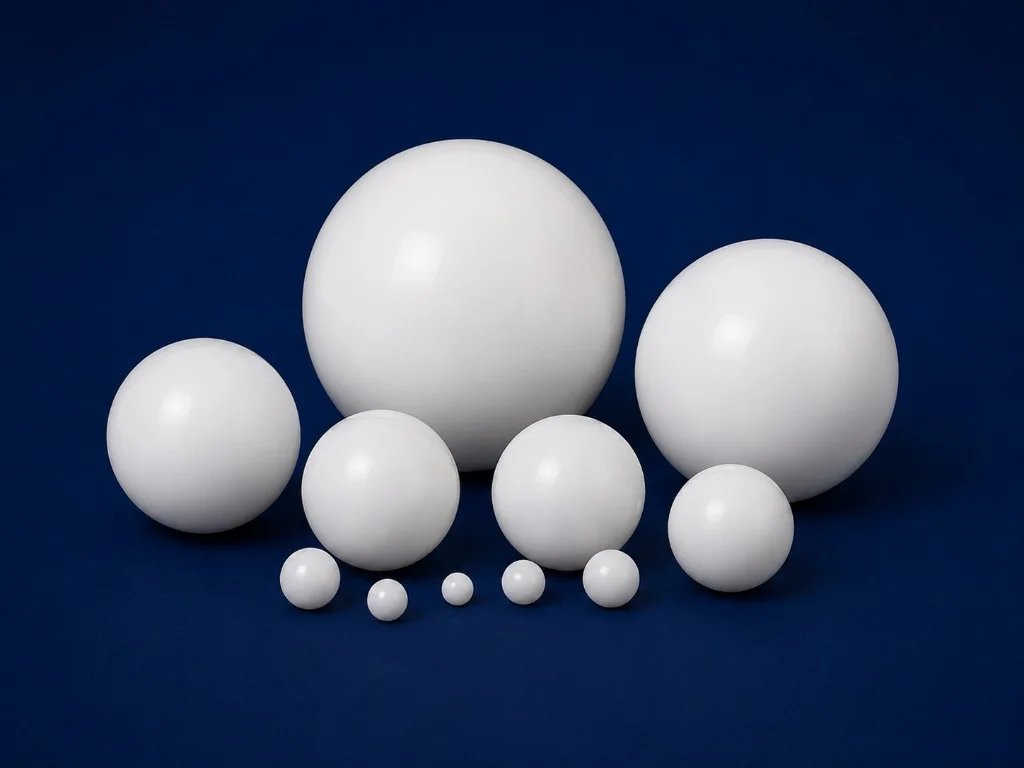
Quick Answer
PTFE pump balls are solid check valve spheres inside reciprocating and diaphragm pumps — especially air-operated double diaphragm (AODD) pumps and chemical dosing pumps. They cycle rapidly, resist aggressive chemicals, and maintain seal integrity over thousands of strokes per hour.
Role of PTFE Balls in Pumps
In a reciprocating or diaphragm pump, check valve balls control fluid direction. On the suction stroke, the inlet ball lifts and allows fluid into the chamber. On the discharge stroke, the outlet ball opens while the inlet ball reseats. PTFE is the material of choice when the pumped media includes concentrated acids, solvents, viscous chemicals, or sanitary process fluids.
Unlike metal balls, PTFE pump balls will not corrode, gall, or contaminate the process. Unlike rubber balls, they withstand temperatures to +260°C and resist swelling in solvents. For product specifications see virgin PTFE balls.
AODD Pump Check Balls
Air-operated double diaphragm (AODD) pumps are the most common application for PTFE pump balls. Each diaphragm chamber has an inlet and outlet check valve containing a ball and seat. Balls may cycle 200–400 times per minute in continuous duty.
-
Clean chemical service: Virgin PTFE — maximum chemical purity, lowest friction.
-
Abrasive slurries: Glass-filled or carbon-filled PTFE via custom compounds (/custom-ptfe-ball) — higher hardness, longer wear life.
-
Sanitary dosing: FDA-compliant virgin PTFE — dairy, beverage, pharmaceutical ingredient pumps.
Other Pump Types Using PTFE Balls
| Pump Type | Ball Function | Typical Size | Stress Factor |
|---|---|---|---|
| AODD (air-operated diaphragm) | Inlet/outlet check sphere | 12.7 – 50.8 mm | High cycle fatigue |
| Chemical dosing / metering | Precision check valve ball | 6 – 12.7 mm | Tight tolerance, chemical purity |
| Reciprocating piston pump | Suction/discharge check | 9.52 – 25.4 mm | Impact + chemical |
| Sanitary lobe/diaphragm pump | CIP-compatible check ball | 12.7 – 19.05 mm | Steam sterilization |
| HPLC / chromatography pump | High-pressure check sphere | 3 – 6 mm | High pressure, solvent contact |
Wear Life and Grade Selection
PTFE pump ball wear depends on:
-
Cycle rate — higher frequency = faster wear
-
Media abrasiveness — slurries and particulates accelerate erosion
-
Seat material — sharp or rough seats damage soft virgin PTFE faster
-
Pressure differential — high ΔP increases impact energy per cycle
For abrasive duties, specify glass-filled (typically 15–25% glass fiber) or carbon-filled PTFE. For clean chemical dosing, virgin PTFE maximizes purity and minimizes stiction. Use our selection guide to narrow grade.
Replacing Pump Balls — What to Specify
When ordering replacement PTFE pump balls, provide: pump manufacturer and model, ball diameter (or send worn sample), media type, and operating temperature. We machine to drawing or match physical samples. Standard lead time for stock sizes is 24–48 hours; custom compounds 10–15 business days.
Related Guides
-
PTFE Valve Balls (/ptfe-valve-balls) — check valve applications
-
PTFE Balls by Industry (/ptfe-balls-by-industry) — sector-specific uses
-
Full Applications Guide (/ptfe-ball-applications)
-
How to Buy PTFE Balls (/how-to-buy-ptfe-balls) — RFQ checklist
Technical specifications and application guidelines
HEMSUN ENGG. INDUSTRIES manufactures and engineers high-precision solutions for ptfe pump balls at our Dahegam, Gujarat facility. Every component and machine is built to international standards with complete dimensional traceability.
Comparative Engineering Data Matrix
| Specification / Property | Virgin PTFE / Standard Range | Filled / High-Performance Variant | Testing Standard |
|---|---|---|---|
| Specific Gravity / Density | 2.14 to 2.18 g/cm³ | 2.20 to 3.80 g/cm³ (by filler type) | ASTM D792 |
| Tensile Strength at Break | 20 to 35 MPa (2,900–5,000 psi) | 15 to 25 MPa | ASTM D4894 |
| Elongation at Break | 250% to 450% | 100% to 300% | ASTM D4894 |
| Operating Temperature Range | -200°C to +260°C (-328°F to +500°F) | -200°C to +280°C | Continuous Service |
| Dielectric Strength | 50 to 80 kV/mm (0.1 mm film) | 15 to 40 kV/mm | ASTM D149 |
| Coefficient of Friction | 0.05 to 0.10 (Dynamic against steel) | 0.08 to 0.15 | ASTM D1894 |
Procurement & Quality Assurance Checklist
- Material Traceability: 100% virgin suspension resin or certified filler masterbatch with raw material test reports (MTR).
- Dimensional Verification: CMM coordinate inspection, digital micrometer checks, and optical surface roughness profilometry (Ra ≤ 0.4 µm).
- Packaging & Shipping: Domestic delivery via express road freight with GST tax invoices; global exports in seaworthy crating with IEC certificate of origin and commercial invoices.