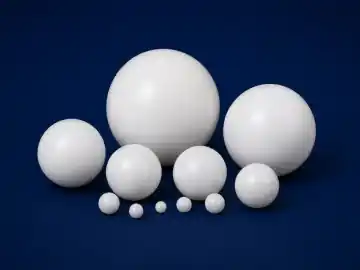

PTFE Ball for Steam Service — what steam does to a check ball
Steam is not chemically hard on PTFE — the polymer handles it. What steam does is combine heat with cycling, and that combination attacks the two things a check ball depends on: dimensional stability at temperature, and a filler that will not be corroded by hot water.
Where PTFE Ball for Steam Service is used
Carbon-filled is usually the right answer for steam and hot condensate — it holds up in wet heat and conducts heat away from the seating band. Glass-filled is the alternative where the condensate is also chemically aggressive. Unfilled PTFE is acceptable only for intermittent, lower-temperature duty.
Failure shows as a flattened seating band and rising passing-flow rather than as visible wear. Because the deformation is thermal, a ball that is replaced and immediately deforms again is telling you the grade is wrong, not that the part was faulty.
Key properties
Service
saturated and superheated steam, condensate return
Typical failure
softening and permanent set at temperature, or filler corrosion
How it behaves here
PTFE softens progressively as it approaches the upper end of its service band, so a ball that seats perfectly cold can take a permanent flat at the seating band when hot and cycling. The compound choice governs how far that goes: an unfilled ball deforms soonest, a glass- or carbon-filled ball holds its sphericity considerably longer.
Where it does not belong
Bronze-filled balls do not belong in steam. The bronze corrodes in hot water and condensate, and the corrosion products both contaminate the line and roughen the seating surface. This is the single most common wrong specification for steam duty.
Specifications
| Property | Value |
|---|---|
| Service condition | Saturated / superheated steam, condensate |
| Recommended compounds | Carbon-filled PTFE; glass-filled where condensate is aggressive |
| Avoid | Bronze-filled — corroded by hot water and condensate |
| Governing factor | Permanent set at temperature; filler corrosion |
| Form supplied | Solid ball, machined and lapped to drawing |
| Sizing note | Size against the seat at working temperature |
Manufacturing process
Compression moulded and sintered, then machined and lapped to the sphericity grade your seat requires.
Material selection notes
PTFE softens progressively as it approaches the upper end of its service band, so a ball that seats perfectly cold can take a permanent flat at the seating band when hot and cycling. The compound choice governs how far that goes: an unfilled ball deforms soonest, a glass- or carbon-filled ball holds its sphericity considerably longer.
How to specify your order
Carbon-filled is usually the right answer for steam and hot condensate — it holds up in wet heat and conducts heat away from the seating band. Glass-filled is the alternative where the condensate is also chemically aggressive. Unfilled PTFE is acceptable only for intermittent, lower-temperature duty.
Quality checks and inspection
Dimensions are verified on CMM against your drawing. Filler content and sintered density are checked per ASTM D792, with tensile and elongation per ASTM D4894. A mill test certificate stating the lot, filler content and measured values ships with the order.
Ordering and export documentation
Size the ball against the seat at the working temperature, not on the bench. A ball and a metal seat expand at very different rates, and a fit that is correct cold can be either tight or leaking once the line is up to temperature.
Export packing and lead time
HEMSUN is a DGFT IEC registered exporter (Government of India). Commercial invoice, packing list and certificate of origin accompany international despatch.
Storage and handling
Failure shows as a flattened seating band and rising passing-flow rather than as visible wear. Because the deformation is thermal, a ball that is replaced and immediately deforms again is telling you the grade is wrong, not that the part was faulty.
Compliance & Standards
HEMSUN is a DGFT IEC registered exporter (Government of India). Filler content and sintered density are verified per ASTM D792 on each batch, with tensile and elongation checked per ASTM D4894.
Frequently Asked Questions
What PTFE Ball for Steam Service options does HEMSUN manufacture?
Steam is not chemically hard on PTFE — the polymer handles it. What steam does is combine heat with cycling, and that combination attacks the two things a check ball depends on: dimensional stability at temperature, and…
Can you supply PTFE Ball for Steam Service for OEM and export orders?
Yes. We support prototype lots, recurring OEM programmes, and export packing with material certificates and dimensional inspection reports on request. Typical RFQ response is within one business day when drawings are complete.
How do I request a quote for PTFE Ball for Steam Service?
Send material grade, dimensions or drawing, quantity, application media, and operating temperature/pressure via https://hemsun.com/contact. Our engineering team confirms manufacturability, lead time, and pricing.