
PTFE Ball for Cryogenic Service — why PTFE and almost nothing else
Cryogenic duty is where PTFE has almost no competition. Elastomers glass-transition and shatter, most engineering plastics embrittle, and metal-to-metal seating leaks. PTFE keeps useful flexibility down towards −200 °C, which is why cryogenic valves and pumps specify it as a matter of course.
Where PTFE Ball for Cryogenic Service is used
Glass-filled is usually preferred over unfilled for cryogenic seating because it contracts less and resists the cold flow that ambient-temperature clamping loads still cause. Bronze-filled is avoided where the service is also oxygen — see oxygen service for why.
Cryogenic components usually fail through thermal cycling rather than running wear. Repeated warm-cold cycles work the seating band, so cycle count and the number of cool-downs matter more than hours in service.
Key properties
Service
LNG, liquid nitrogen, oxygen and argon handling
Typical failure
contraction-driven fit loss, not material failure
How it behaves here
PTFE does not have a sharp low-temperature transition the way an elastomer does — it stiffens progressively but continues to conform under seating load. That residual conformability is what maintains shutoff at a temperature where a metal seat would leak through thermal distortion alone.
Where it does not belong
The engineering problem at cryogenic temperature is dimensional, not chemical. PTFE contracts substantially more than the metal around it, so a ball sized for ambient conditions can be badly undersized cold. Filled grades contract less than unfilled, which is often the real reason to specify one.
Specifications
| Property | Value |
|---|---|
| Service condition | Cryogenic — LNG, LIN, LOX, argon |
| Recommended compounds | Glass-filled PTFE; unfilled where contraction is designed for |
| Governing factor | Thermal contraction relative to the metal seat |
| Avoid | Elastomer balls — glass transition and embrittlement |
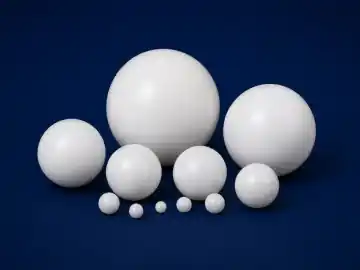
| Form supplied | Solid ball, machined and lapped to drawing |
| Sizing note | State whether the drawing dimension is ambient or operating |
Manufacturing process
Compression moulded and sintered, then machined and lapped. Sphericity is verified at ambient with the operating-temperature fit calculated from it.
Material selection notes
PTFE does not have a sharp low-temperature transition the way an elastomer does — it stiffens progressively but continues to conform under seating load. That residual conformability is what maintains shutoff at a temperature where a metal seat would leak through thermal distortion alone.
How to specify your order
Glass-filled is usually preferred over unfilled for cryogenic seating because it contracts less and resists the cold flow that ambient-temperature clamping loads still cause. Bronze-filled is avoided where the service is also oxygen — see oxygen service for why.
Quality checks and inspection
Dimensions are verified on CMM against your drawing. Filler content and sintered density are checked per ASTM D792, with tensile and elongation per ASTM D4894. A mill test certificate stating the lot, filler content and measured values ships with the order.
Ordering and export documentation
Calculate the fit at operating temperature. This is the single most important step in cryogenic component specification and the most commonly skipped one: a ball that seats correctly on the bench may not seat at all at −180 °C.
Export packing and lead time
HEMSUN is a DGFT IEC registered exporter (Government of India). Commercial invoice, packing list and certificate of origin accompany international despatch.
Storage and handling
Cryogenic components usually fail through thermal cycling rather than running wear. Repeated warm-cold cycles work the seating band, so cycle count and the number of cool-downs matter more than hours in service.
Compliance & Standards
HEMSUN is a DGFT IEC registered exporter (Government of India). Filler content and sintered density are verified per ASTM D792 on each batch, with tensile and elongation checked per ASTM D4894.
Frequently Asked Questions
What PTFE Ball for Cryogenic Service options does HEMSUN manufacture?
Cryogenic duty is where PTFE has almost no competition. Elastomers glass-transition and shatter, most engineering plastics embrittle, and metal-to-metal seating leaks. PTFE keeps useful flexibility down towards −200 °C,…
Can you supply PTFE Ball for Cryogenic Service for OEM and export orders?
Yes. We support prototype lots, recurring OEM programmes, and export packing with material certificates and dimensional inspection reports on request. Typical RFQ response is within one business day when drawings are complete.
How do I request a quote for PTFE Ball for Cryogenic Service?
Send material grade, dimensions or drawing, quantity, application media, and operating temperature/pressure via https://hemsun.com/contact. Our engineering team confirms manufacturability, lead time, and pricing.