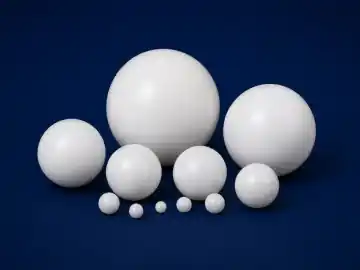

PTFE Ball for Abrasive Slurry — where the wear actually happens
In abrasive slurry the usual assumption is wrong. The ball is not normally what fails first — the seat is, because solids are trapped and ground at the seating interface every time the ball lands. Specifying for slurry means specifying the pair, not just the ball.
Where PTFE Ball for Abrasive Slurry Service is used
Choose PTFE when the carrier fluid is chemically aggressive and abrasion is secondary. Choose UHMWPE when abrasion dominates and the chemistry is mild. Filled PTFE grades sit between the two but the abrasive filler can itself accelerate seat wear, which is why a filled ball is not automatically the answer in slurry.
Passing flow rises as the seat erodes. If a new ball leaks immediately, the seat is the problem; if it seals then degrades over weeks, the ball material is being consumed and a harder-wearing compound is worth trialling.
Key properties
Service
mineral slurry, ceramic slip, pigment and filler suspensions
Typical failure
seat erosion and trapped solids, not ball wear
How it behaves here
Each closure traps particles between two hard surfaces. A softer ball tends to embed the particle and carry it clear, whereas a very hard ball grinds it into the seat. That is the counter-intuitive reason a somewhat more compliant material can give longer system life in slurry, even though it wears faster itself.
Where it does not belong
PTFE is chemically ideal for most slurries but not the most abrasion-resistant polymer available. Where the slurry is highly abrasive and chemically benign, UHMWPE is frequently the better engineering choice and PTFE is being specified out of habit.
Specifications
| Property | Value |
|---|---|
| Service condition | Abrasive slurry, ceramic slip, pigment suspension |
| Governing factor | Seat erosion from trapped solids |
| PTFE suits | Chemically aggressive carrier fluid |
| Consider instead | UHMWPE where abrasion dominates and chemistry is mild |
| Form supplied | Solid ball, machined and lapped to drawing |
| Specify together | Ball and seat as a pair, not the ball alone |
Manufacturing process
Compression moulded and sintered, then machined and lapped. UHMWPE alternatives are machined from stock where that material is the better fit.
Material selection notes
Each closure traps particles between two hard surfaces. A softer ball tends to embed the particle and carry it clear, whereas a very hard ball grinds it into the seat. That is the counter-intuitive reason a somewhat more compliant material can give longer system life in slurry, even though it wears faster itself.
How to specify your order
Choose PTFE when the carrier fluid is chemically aggressive and abrasion is secondary. Choose UHMWPE when abrasion dominates and the chemistry is mild. Filled PTFE grades sit between the two but the abrasive filler can itself accelerate seat wear, which is why a filled ball is not automatically the answer in slurry.
Quality checks and inspection
Dimensions are verified on CMM against your drawing. Filler content and sintered density are checked per ASTM D792, with tensile and elongation per ASTM D4894. A mill test certificate stating the lot, filler content and measured values ships with the order.
Ordering and export documentation
Check seat condition at every ball change, and specify a seat material deliberately rather than inheriting it. Replacing only the ball in a slurry line is usually why the second ball fails faster than the first.
Export packing and lead time
HEMSUN is a DGFT IEC registered exporter (Government of India). Commercial invoice, packing list and certificate of origin accompany international despatch.
Storage and handling
Passing flow rises as the seat erodes. If a new ball leaks immediately, the seat is the problem; if it seals then degrades over weeks, the ball material is being consumed and a harder-wearing compound is worth trialling.
Compliance & Standards
HEMSUN is a DGFT IEC registered exporter (Government of India). Filler content and sintered density are verified per ASTM D792 on each batch, with tensile and elongation checked per ASTM D4894.
Frequently Asked Questions
What PTFE Ball for Abrasive Slurry Service options does HEMSUN manufacture?
In abrasive slurry the usual assumption is wrong. The ball is not normally what fails first — the seat is, because solids are trapped and ground at the seating interface every time the ball lands. Specifying for slurry…
Can you supply PTFE Ball for Abrasive Slurry Service for OEM and export orders?
Yes. We support prototype lots, recurring OEM programmes, and export packing with material certificates and dimensional inspection reports on request. Typical RFQ response is within one business day when drawings are complete.
How do I request a quote for PTFE Ball for Abrasive Slurry Service?
Send material grade, dimensions or drawing, quantity, application media, and operating temperature/pressure via https://hemsun.com/contact. Our engineering team confirms manufacturability, lead time, and pricing.