Glass-Filled PTFE Bush — why this filler for this component
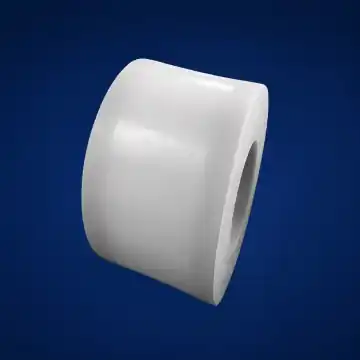
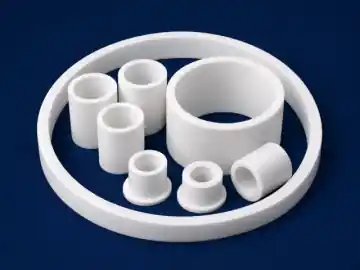
Glass filling is specified for a bush when the shaft turns slowly under a sustained load and the problem is not heat but creep. Unfilled PTFE deforms gradually under constant pressure; the bore closes in, clearance disappears and the bush binds. Glass fibre reinforcement holds the bore dimension over time.
Where Glass-Filled PTFE Bush is used
Against a bronze-filled bush
glass keeps most of PTFE’s chemical resistance, so it survives in process fluids that would strip bronze. It carries less load and conducts far less heat, so on hot, fast, heavily loaded duty the bronze grade is the better engineering answer.
Failure usually shows as shaft wear rather than bush wear when the counterface is too soft, and as gradual bore loss where the counterface is correctly specified. Inspect the shaft as well as the bush at service intervals.
Key properties
Compound
Glass-Filled PTFE, typically 15% or 25% glass fibre
How it works here
The fibres act as internal reinforcement that resists cold flow at both low and high temperature. For a bush that means the running clearance you set at commissioning is still approximately the clearance you have a year later, which is exactly what a slow-moving, heavily preloaded bearing needs.
Where it does not belong
Friction is higher than unfilled PTFE, and the fibres are abrasive. Against aluminium, brass or a thinly plated bore, a glass-filled bush will wear the shaft rather than itself — the opposite of what a plain bearing is supposed to do. Hydrofluoric acid and strong alkali attack the glass even though PTFE resists them.
Specifications
| Property | Value |
|---|---|
| Compound | Glass-filled PTFE, typically 15% or 25% glass fibre |
| Duty | Sustained radial load, low to moderate speed |
| Inner Diameter | To drawing — commonly 5 mm to 300 mm |
| Counterface | Hardened steel; avoid aluminium, brass and thin plating |
| Governing factor | Creep resistance under sustained load |
| Not suitable for | Hydrofluoric acid, strong alkali, soft counterfaces |
Manufacturing process
Compression moulded from 15% or 25% glass fibre compound, sintered, then machined to your drawing. Filled compounds need higher compaction pressure than unfilled PTFE to reach full density through the section.
Material selection notes
The fibres act as internal reinforcement that resists cold flow at both low and high temperature. For a bush that means the running clearance you set at commissioning is still approximately the clearance you have a year later, which is exactly what a slow-moving, heavily preloaded bearing needs.
How to specify your order
Against a bronze-filled bush: glass keeps most of PTFE’s chemical resistance, so it survives in process fluids that would strip bronze. It carries less load and conducts far less heat, so on hot, fast, heavily loaded duty the bronze grade is the better engineering answer.
Quality checks and inspection
Dimensions are verified on CMM against your drawing. Filler content and sintered density are checked per ASTM D792, with tensile and elongation per ASTM D4894. A mill test certificate stating the lot, filler content and measured values ships with the order.
Ordering and export documentation
Check the shaft material before specifying. A hardened steel counterface is fine; soft or plated shafts should push you towards graphite-filled or unfilled grades. Clearance is set for the hot condition as with any PTFE compound.
Export packing and lead time
HEMSUN is a DGFT IEC registered exporter (Government of India). Commercial invoice, packing list and certificate of origin accompany international despatch.
Storage and handling
Failure usually shows as shaft wear rather than bush wear when the counterface is too soft, and as gradual bore loss where the counterface is correctly specified. Inspect the shaft as well as the bush at service intervals.
Compliance & Standards
HEMSUN is a DGFT IEC registered exporter (Government of India). Filler content and sintered density are verified per ASTM D792 on each batch, with tensile and elongation checked per ASTM D4894.
Frequently Asked Questions
What Glass-Filled PTFE Bush options does HEMSUN manufacture?
Glass filling is specified for a bush when the shaft turns slowly under a sustained load and the problem is not heat but creep. Unfilled PTFE deforms gradually under constant pressure; the bore closes in, clearance disa…
Can you supply Glass-Filled PTFE Bush for OEM and export orders?
Yes. We support prototype lots, recurring OEM programmes, and export packing with material certificates and dimensional inspection reports on request. Typical RFQ response is within one business day when drawings are complete.
How do I request a quote for Glass-Filled PTFE Bush?
Send material grade, dimensions or drawing, quantity, application media, and operating temperature/pressure via https://hemsun.com/contact. Our engineering team confirms manufacturability, lead time, and pricing.